
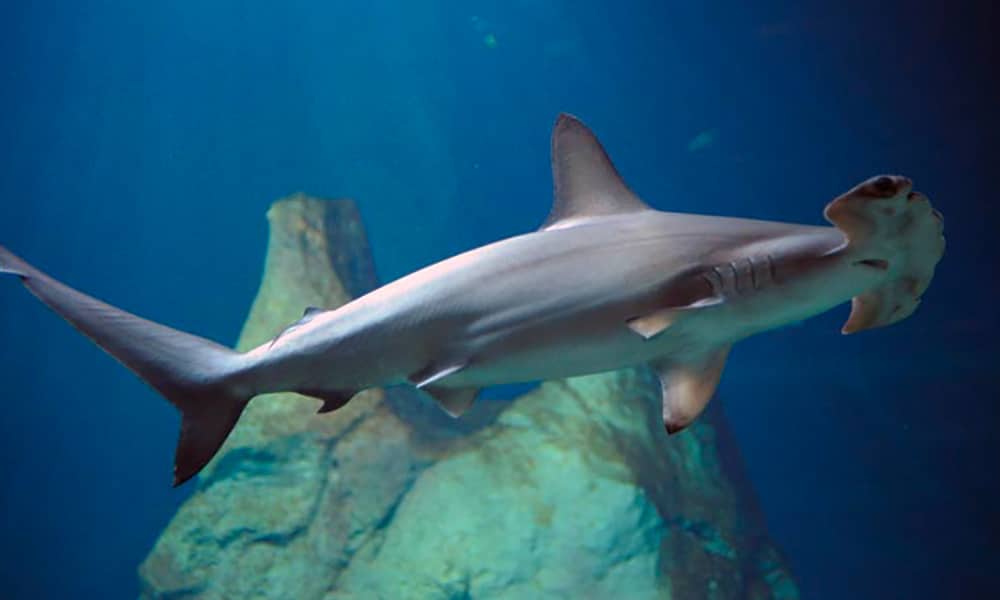
Scientific name : Sphyrna lewini
Family : Sphyrnidae
Size : Up to 350 cm
Distribution : Tropical seas of the world
Biology :
The scalloped hammerhead shark is one of the emblematic species of the Aquarium of Biarritz, the only aquarium in France to keep one in captivity.
This specimen arrived in May 2011. It is not only the oldest scalloped hammerhead in Europe but also the very first to be housed in an aquarium on the continent.
The shark’s striking head is a major asset for its survival. It has wide, groove-shaped nostrils that span half the width of its skull, giving it an exceptionally keen sense of smell. Like all sharks, it also possesses sensory receptors called ampullae of Lorenzini, which allow it to detect electromagnetic fields. Thanks to the broad shape of its snout, this sense is particularly well developed in this species. Despite its unusual appearance, the head is very hydrodynamic.
This species is viviparous: the embryo develops inside the female’s body, and the young are nourished via a placenta. The female gives birth to 15 to 30 pups at a time. The average generation time for the species is around 24 years, which is very long for a fish.
Scalloped hammerheads can sometimes be observed in very large schools near drop-offs, a behavior that increases their hunting efficiency. However, as the species is in decline, it is becoming increasingly rare to witness this spectacular behavior.
The species is severely threatened by fishing, particularly as bycatch in industrial deep-sea fisheries. Attacks by scalloped hammerhead sharks are extremely rare, and none have ever been fatal.
The scalloped hammerhead shark has experienced a dramatic global decline, estimated between –77% and –97% over the past 70 years.
IUCN status : Critically endangered